Most people think mezcal comes from one plant.
It doesn’t.
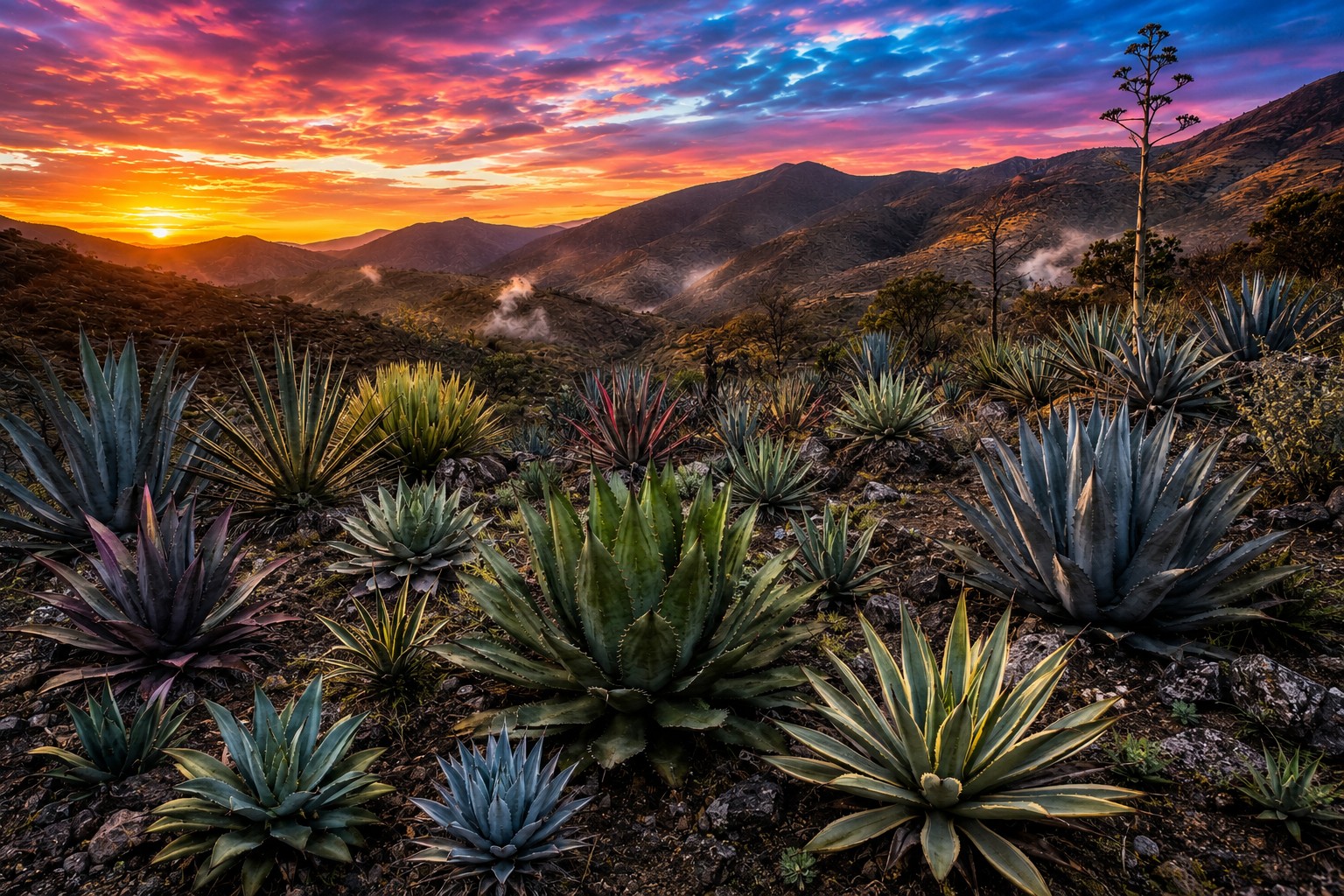
In fact, mezcal can legally be made from more than 40 different agave species.
And honestly?
That’s one of the things that makes mezcal endlessly fascinating.
Because agave is not just a raw ingredient.
It’s personality.
Texture.
Environment.
Time.
Wildness.
Geography.
Patience.
Every agave behaves differently.
Every species tastes different.
And every one changes the final mezcal dramatically.
This is the reason we equate the experience of drinking mezcal to that of drinking wine.
Each grape has a different character and taste in the same way that every agave does.
Which, in the end, means mezcal is less like a single spirit category…
and more like an entire world hiding inside one.
First: Agave Isn’t a Cactus
We should probably clear this up immediately.
Agave may look like a cactus.
It isn’t one.
Agave is actually a succulent, part of the Asparagaceae family.
Yes.
Technically, mezcal comes from a distant asparagus relative.
You’ll never unlearn that now.
The agave itself stores sugars in its massive heart, or piña, over many years before eventually flowering once and dying naturally afterward.
That long growth cycle is a huge part of why mezcal feels so connected to time and place.
Some agaves mature relatively quickly.
Others take decades.
Literally.
Some Agaves Grow Fast. Others Take Their Time.
Espadín, by far the most commonly used agave for mezcal, typically matures in roughly 6 to 8 years depending on climate and growing conditions.
That’s already a long time compared to most agricultural crops.
But then things get wild. Literally.
At IBÁ, our Jabalí is sourced exclusively from wild agaves and can take up to 18 years to mature.
Our Tepeztate? Up to 25 years in the wild before it’s ready for harvest.
Think about that for a second.
Someone may begin caring for an agave before the person who will drink the mezcal is even born.
That kind of timeline changes your relationship with the spirit.
It also explains why certain mezcals become dramatically more rare and expensive.
You are not simply paying for alcohol.
You are paying for time.
In a way, mezcal begins aging long before it is ever distilled.
Every Agave Tastes Different
This is where mezcal gets really interesting.
Different agaves create completely different flavor profiles.
Espadín often feels balanced and approachable:
roasted agave,
soft smoke,
citrus,
earth,
minerality.
Tepeztate can become deeply herbal, floral, mineral driven, and wildly complex.
Jabalí often turns bold, intense, earthy, mineral driven, spicy, and unpredictable.
Tobalá can lean aromatic and expressive with fruit and floral notes.
Some agaves feel brighter.
Others darker.
Some become creamy and round.
Others sharp, dry, green, or intensely mineral.
The agave species changes everything:
aroma,
texture,
flavor,
finish,
structure,
even the way smoke integrates into the mezcal itself.
That’s why mezcal lovers can spend years exploring different agaves and still feel like they’ve barely scratched the surface.
Not All Agaves Want the Same Life
Some agaves do beautifully in cultivated fields.
Others are far less cooperative.
Espadín adapts relatively well to organized farming and cultivation, which is one reason it became the backbone of much of the mezcal industry.
But many wild agaves prefer difficult environments:
rocky hillsides,
mountain terrain,
remote cliffs,
harsh elevations,
dry forests.
Some simply resist domestication altogether.
And that creates a very different relationship between mezcaleros and the land.
Wild Agaves Are a Long Game
Here’s something many people outside mezcal culture don’t realize:
Wild agaves are often informally “claimed” years before harvest.
Sometimes decades.
A palenque or mezcal family may identify naturally growing agaves in remote areas and maintain informal stewardship over them long before they mature.
Because if an agave may take 15, 20, or 25 years to become harvest-ready, someone has to think long term.
Extremely long term.
There’s trust involved.
Relationships.
Local understanding.
Generational knowledge.
In many cases, these aren’t fenced industrial operations.
They’re deeply personal connections to land that families have known for generations.
That relationship becomes part of the mezcal itself.
Why Wild Agaves Can Taste So Different
Wild agaves often grow under harsher and more varied conditions than cultivated agaves.
Less predictable water.
Rockier soil.
Greater environmental stress.
More competition with surrounding vegetation.
And stress changes flavor.
Just like wine grapes grown in difficult conditions can become more expressive, wild agaves often develop intense complexity and character over time.
That doesn’t automatically mean “better.”
Just different.
Sometimes dramatically different.
And because wild agaves mature slowly and unpredictably, no two harvests are ever exactly alike.
That variability is part of what makes mezcal feel alive.
This Is Why Mezcal Doesn’t Taste One-Dimensional
A lot of people still assume mezcal equals smoke.
But agave variety is one of the biggest reasons great mezcal becomes so layered.
Smoke is only one piece of the experience.
The agave itself contributes:
fruit,
minerality,
earth,
herbs,
florals,
spice,
texture,
sweetness,
dryness,
acidity,
even salinity.
At IBÁ, that complexity is something we intentionally protect and elevate through our production approach.
The goal is never to bury the agave beneath overpowering smoke.
It’s to allow the agave to speak clearly.
Because every species has something different to say.
So… Which Agave Is “Best”?
Honestly?
That’s like asking which type of music is best.
It depends on:
your palate,
your mood,
the moment,
the setting,
the experience you want.
Some nights call for the balanced versatility of Espadín.
Others call for something wilder and more contemplative like Tepeztate or Jabalí.
That’s part of what makes mezcal so interesting to explore.
There’s always another direction to go.
Another agave.
Another region.
Another expression.
Another surprise.
Maybe That’s Why Mezcal Feels Different
Most spirits chase consistency above all else.
Mezcal still leaves room for unpredictability.
For nature.
For time.
For variation.
For personality.
The agaves grow differently.
The land changes.
The seasons shift.
The mezcal evolves.
Maybe that’s why mezcal tends to feel a little more human than other spirits.
Less manufactured.
More alive.
And once you start understanding the agaves behind it, you begin realizing mezcal is not one flavor.
It’s an entire landscape of possibilities.
Curious? Questions?
Give us a shout at cheers@ibamezcal.com.
(Yes, we really do answer immediately.)
Want to explore the different IBÁ expressions?
There’s an entire world waiting inside the glass.